New in The Lancet Psychiatry: Community-led Visions of Care for Better Mental Health
Jun 02, 2026
What do we really mean when we say “community” in mental health?
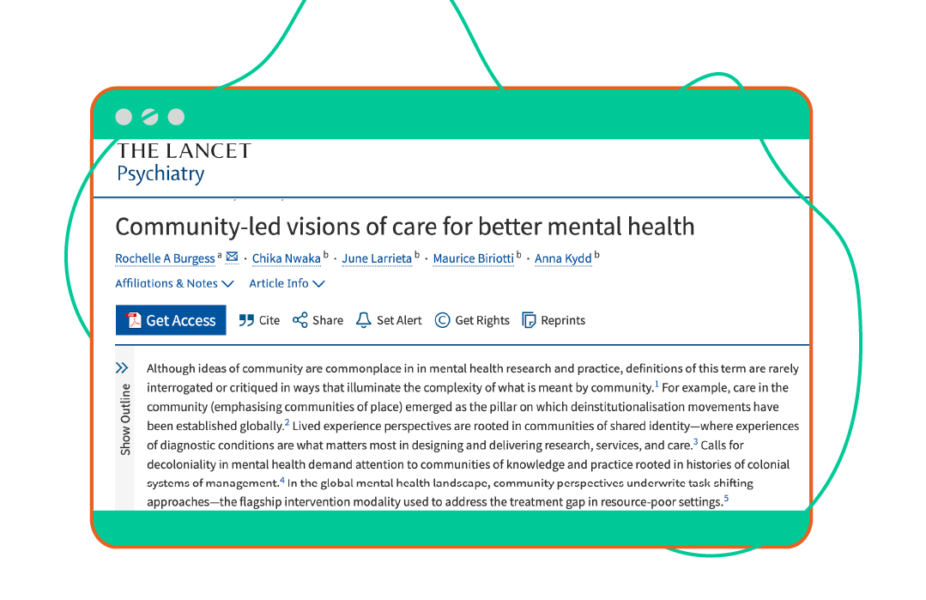
In a new paper published in The Lancet Psychiatry, community-led visions of care for better mental health, Ember Mental Health and Rochelle A Burgess from the Institute for Global Health, University College London, invite the global mental health field to examine this question more critically.
The piece emerged from Ember’s 2024 call-out, which received over 1,800 applications and highlighted the variety of ways in which communities around the world are creating and sustaining their own spaces of care, connection, and support. (Read the Insights Report here) We sought to bring these examples into conversation with an academic audience, and to consider what the wider global mental health field might learn from them.
The paper argues that dominant uses of “community” in mental health, whether understood through place, practice, or shared identity, can obscure the power, agency, and knowledge that shape how care is defined and delivered.
It calls for a shift from community-based approaches, where communities are often positioned as sites of intervention, towards community-led approaches that recognise communities as active makers of care, knowledge, and change.
Drawing on decolonial, disability, and community studies perspectives, the paper argues that mental health care must move beyond narrow service-delivery models and engage with the structural, political, relational, and symbolic realities that shape people’s lives.
Grounded in Ember’s work with over 100 community-led mental health organisations since 2019, the piece shows how care can take many forms: from therapy, peer support, and social work to advocacy, creative expression, employment pathways, and spaces of connection.
Read the paper on Lancet here: https://www.thelancet.com/journals/lanpsy/article/PIIS2215-0366(26)00026-X/abstract
Free access on UCL: https://discovery.ucl.ac.uk/id/eprint/10222824/